Occupy Cinema › Film News
Navigating the Crews: Understanding On Set Hierarchies and Entry Points
Breaking into the film industry, particularly on set, often involves understanding departmental structures and direct outreach, rather than traditional hiring processes. This guide outlines common crew ladders and effective entry strategies.
By Occupy Cinema ·

Securing a position on a film set frequently appears as an opaque process to those outside the industry. The reality, however, is that entry often bypasses conventional human resources departments. Instead, the mechanism relies heavily on individual department heads, who, operating within allocated budgets, are empowered to staff their own teams. This decentralized approach means that direct engagement with a department's 'key' personnel is typically the most effective path to entry.
Consider the camera department, a common aspiration. The typical progression begins as a Camera Production Assistant, advancing to a Second Assistant Camera, then a First Assistant Camera, subsequently to a Camera Operator, and ultimately to a Director of Photography. Each rung requires a distinct skill set and a proven understanding of the preceding roles. For those interested in the visual mechanics of filmmaking, understanding the Alexa 35, Primo lenses, and the nuances of various aspect ratios, from 1.85:1 to 2.39:1, is foundational. This is not merely about operating a camera, but about understanding the craft's technical bedrock.
Departmental Ladders and Strategic Entry
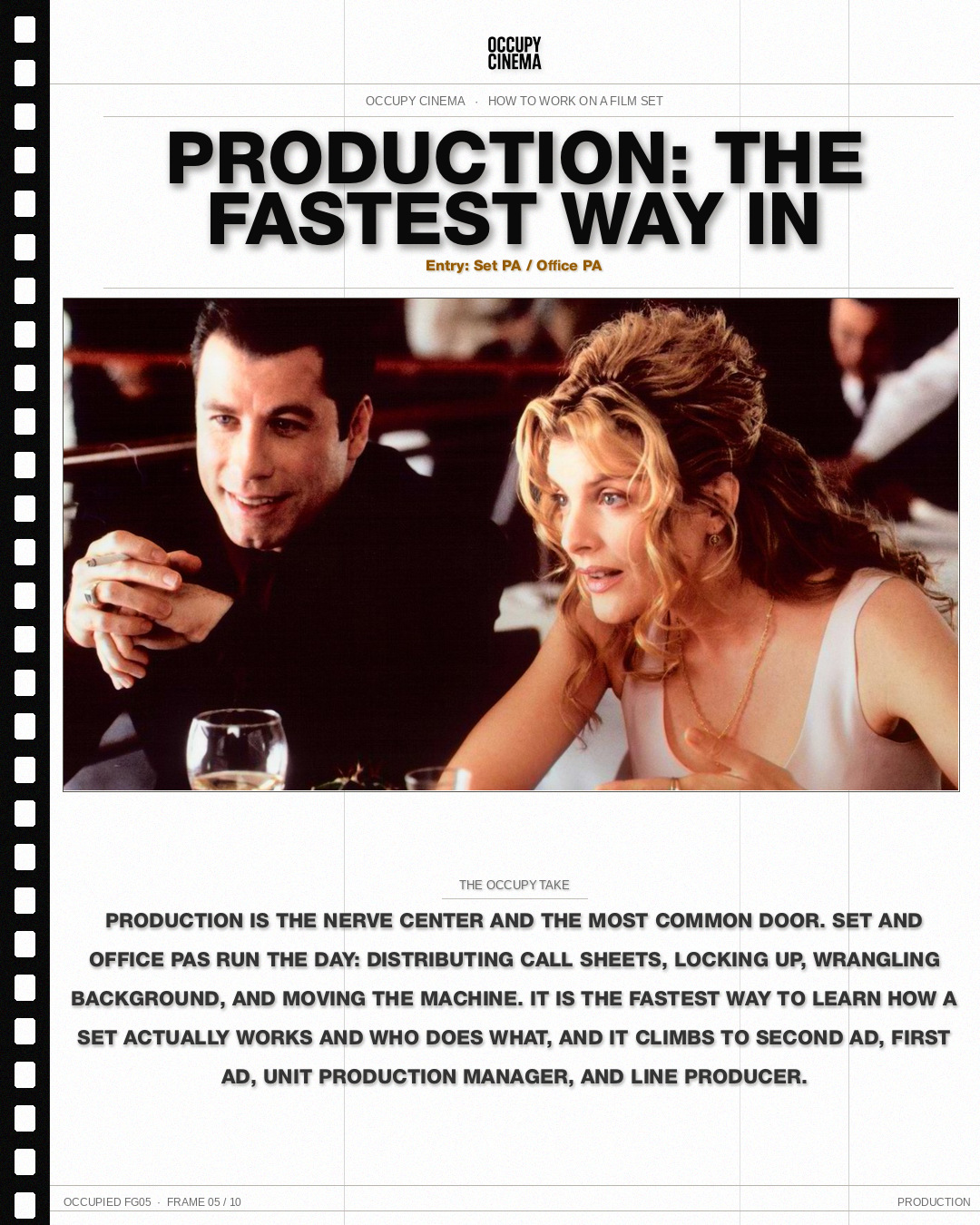
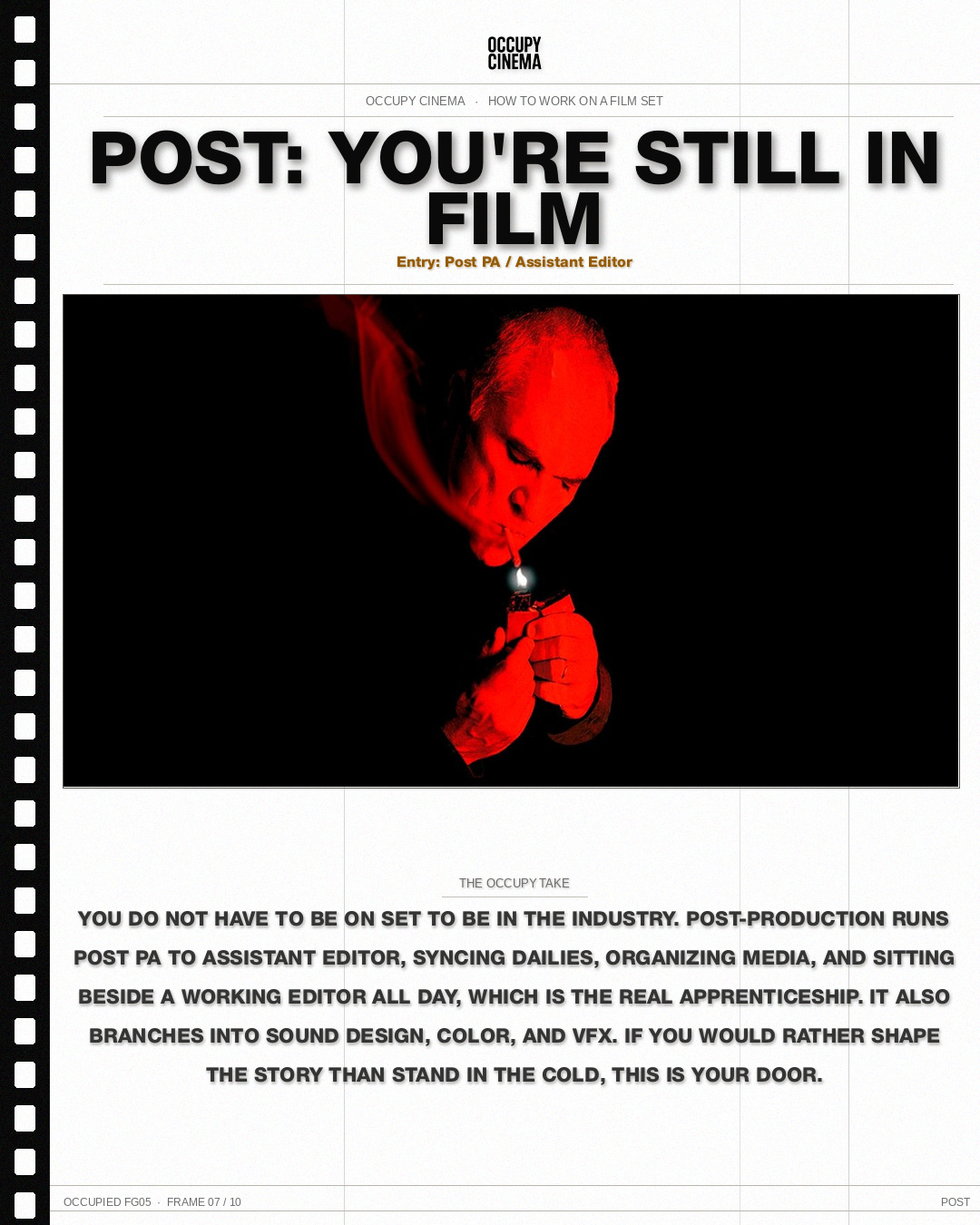
Other departments offer equally structured, albeit distinct, career trajectories. Grip and Electric, for instance, focuses on lighting and rigging. This department is often cited as a reliable route into union membership, given the consistent demand for skilled labor in shaping light and ensuring set safety. The Art Department, responsible for the visual aesthetic of the environment, progresses from Set Dresser to Art Director, culminating in the role of Production Designer. Production itself, the logistical backbone, spans from Set PA to First Assistant Director, and eventually to Unit Production Manager. Post-production, a critical phase, sees individuals move from Post PA to Assistant Editor, and finally to Editor.
Beyond these, specialized crafts such as Sound, Wardrobe, and Hair and Makeup present their own well-defined ladders. Each demands specific expertise and a high degree of dedication. The core principle for entry across all these departments remains consistent: identify the craft that genuinely interests you, something you can commit to for twelve-hour days. Then, the practical step involves locating a department key or a mid-level crew member. Commission lists, accessible through production offices, or even social media platforms like Instagram, can provide these contacts. The outreach should be direct and succinct, emphasizing local availability, reliability, and the possession of personal transportation, coupled with an explicit offer to serve as a Production Assistant.
The Importance of Persistence and Practicality
The initial phase demands a consistent and unequivocal affirmation to all tasks presented. This 'say yes to everything' philosophy, maintained for approximately a year, is widely considered the most effective method for establishing oneself within the industry. It builds trust, demonstrates a strong work ethic, and allows for the acquisition of invaluable on-set experience that formal education often cannot replicate. This practical immersion is how many notable cinematographers, such as Roger Deakins, began their careers, often through 16mm or 35mm short films before graduating to larger formats like 65mm. The process relies less on academic credentials and more on demonstrated capability and interpersonal reliability. For further reading on industry practices, resources like The Hollywood Reporter or Variety frequently publish insights into industry career paths and trends.