Occupy Cinema › Development
How Christopher Nolan and Bill Irwin Used Classical Art to Redefine Creature Design in The Odyssey
To bring the legendary Cyclops to life in The Odyssey, Christopher Nolan and veteran performer Bill Irwin turned to Francisco Goya's Black Paintings, fusing classical fine art with physical craft.
By Occupy Cinema ·
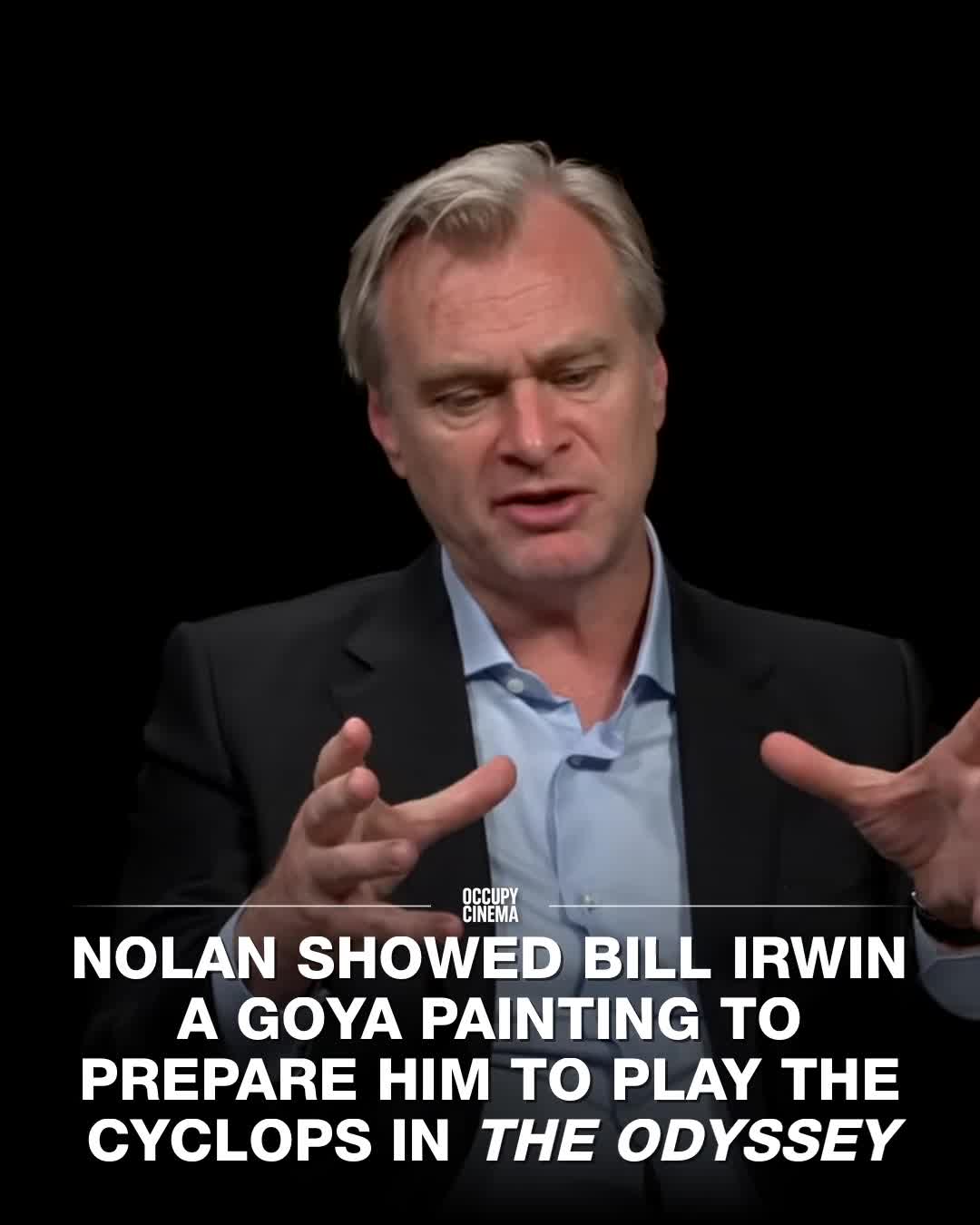
When modern cinema approaches ancient mythology, the immediate instinct of contemporary Hollywood is often to reach for the digital brush. Gigantic set pieces are frequently surrendered to post, production rendering suites, stripping mythical creatures of weight, mass, and physical consequence. Yet, in the hands of Christopher Nolan, an epic narrative canvas becomes an arena for rigorous practical discipline. For his adaptation of Homer's ancient epic, The Odyssey, the director turned to a physical performer capable of instilling mechanical and monstrous creations with profound humanity: Bill Irwin. The collaboration marks a fascinating continuation of a creative partnership that consistently prioritizes physical weight over digital convenience.
To prepare Irwin for the daunting role of the Cyclops, Nolan did not hand the actor a stack of visual effects concept sketches or digital pre, visualizations. Instead, he presented him with a print of Francisco Goya's masterwork, Saturn Devouring His Son, one of the Spanish painter's iconic Black Paintings. The reference was not intended to inspire visceral gore or slasher, style terror. Rather, Nolan pointed Irwin toward the disturbing blankness in the creature's expression. The psychological core of the image lies in the complete absence of self, awareness; from the perspective of the monster, it is not committing an act of evil, but merely existing according to its nature.
This artistic mandate highlights Nolan's distinct approach to character psychology, where even legendary beasts are driven by an internal, unblinking logic. For Irwin, translating that psychological detachment into physical movement required a deep background in physical theater and biomechanics. Moviegoers are already familiar with Irwin's unique abilities through his work on Interstellar, where he voiced and physically puppeteered the monolithic tactical robots TARS and CASE. In that 2014 sci, fi landmark, Irwin spent months maneuvering eighty, pound metal rigs on location in Iceland and on soundstages, giving life to characters that easily could have been rendered entirely via computer graphics.
Building Myth from the Inside Out
The preparation for the Cyclops sequence required a similar level of commitment, spanning months of intensive technical and physical development. Working through a complex combination of puppetry, animatronics, and motion capture technology, Irwin built the character from the inside out. Rather than acting as a simple spatial placeholder for visual effects artists to paint over in post, production, Irwin engineered the movement, weight distribution, and subtle gestural vocabulary of the giant in real time. This hybrid methodology ensures that the creature interacts with light, shadow, and fellow actors with a tangible, tactile realism that purely digital assets rarely achieve.
This commitment to physical presence is central to Nolan's ongoing crusade to preserve traditional cinematic craft within the studio system. Throughout his career, the filmmaker has consistently pulled from classical art history to anchor his high, concept cinematic visions. Just as the warped, distorted figures of painter Francis Bacon influenced the grotesque makeup and chaotic presence of Heath Ledger's Joker in The Dark Knight, Goya's haunting portraiture now provides the psychological foundation for an ancient mythical giant. By grounding spectacle in fine art and physical performance, Nolan elevates grand studio filmmaking into a discourse on human, and superhuman, psychology.
Ultimately, the collaboration between Nolan and Irwin on the Cyclops sequence illustrates a crucial truth about the state of modern cinema. Visual effects can create scale, but only human intention and physical craft can convey gravity. By approaching a legendary monster through the lens of Goya's silent blankness, Irwin and Nolan remind audiences that the most terrifying visual moments are not those designed to startle, but those that force us to look into an expression that feels terrifyingly indifferent to its own brutality. It is a masterclass in modern creature craft, proving once again that true cinematic scale is constructed from the ground up.
Related reading: Respect for Acting.