Occupy Cinema › Business
The Shifting Landscape of Film Production and Incentive-Driven Geography
Film production is increasingly decentralizing from traditional hubs, driven by robust tax incentives and localized infrastructure development. This shift presents new opportunities for aspiring filmmakers outside Los Angeles and New York.
By Occupy Cinema ·

The long-held axiom that a career in film necessitates relocation to Los Angeles or New York City is increasingly outdated. While these cities retain significant industry presence, the geographical distribution of film production has undergone a substantial realignment. This shift is primarily attributable to aggressive state and national tax incentive programs, which have effectively redirected production pipelines to regions offering more favorable financial conditions.
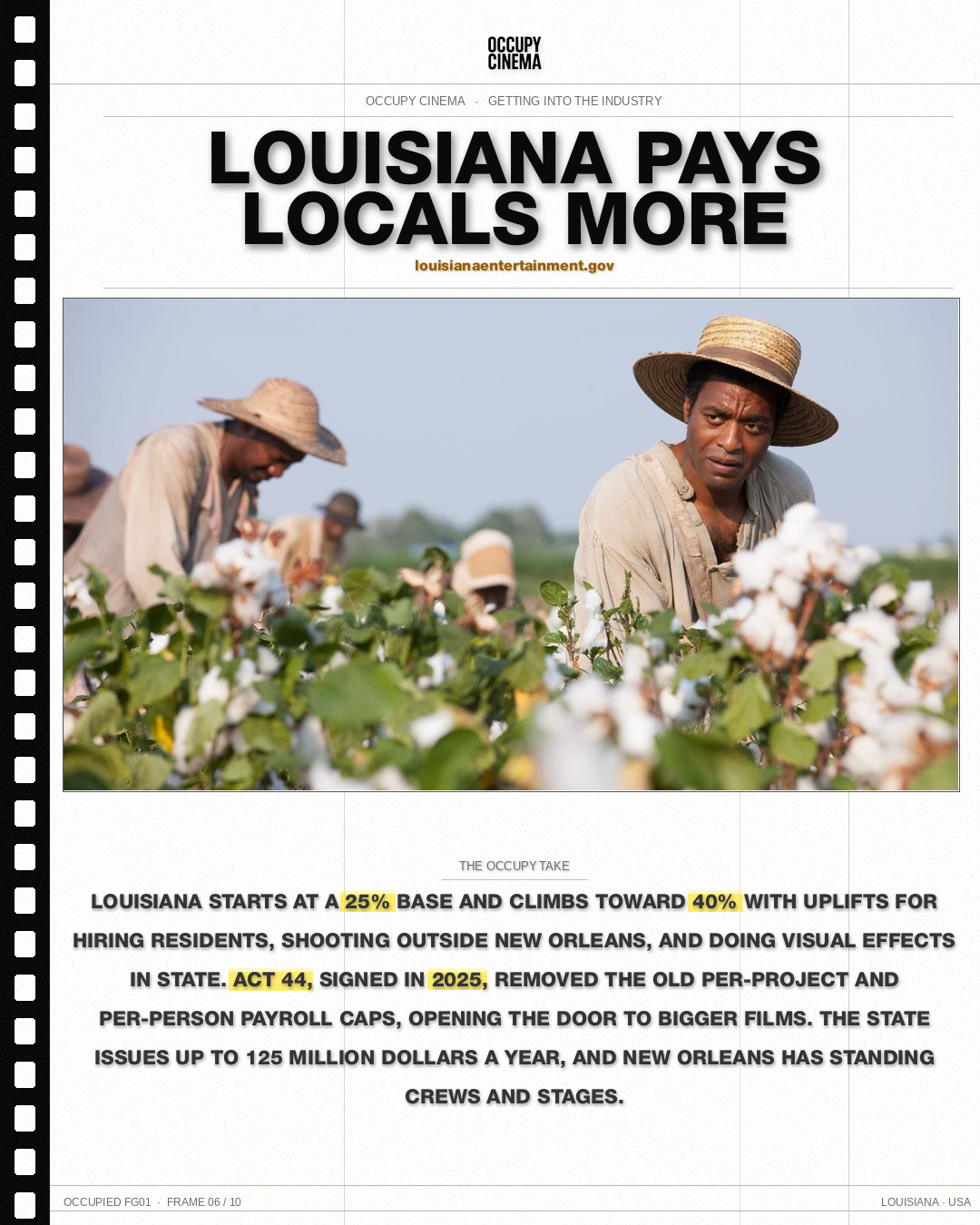
Consider the landscape within the United States. Georgia, for instance, offers a base tax credit of 20 percent, escalating to 30 percent with the inclusion of the state logo, a fully transferable credit without an annual cap. Furthermore, the state is reinstating a dedicated post-production credit as of January 2026. Texas has established a substantial 1.5 billion dollar program, albeit with a requirement for 35 percent local cast and crew employment. New Mexico supports permanent studio facilities for entities such as Netflix and NBCUniversal, backed by a 140 million dollar cap. Louisiana, following Act 44, is progressing towards a 40 percent credit after removing previous caps in 2025. These figures are not trivial, they represent significant financial considerations for studios and independent producers evaluating project viability.
International Incentives and Local Engagement
The trend extends globally. The United Kingdom provides up to 39.75 percent on films budgeted under 15 million pounds. Ireland offers 32 percent, increasing to 40 percent for projects under 20 million euros. British Columbia, in Canada, will offer 36 percent as of 2025, and Australia maintains a 30 percent credit with no cap. These international incentives are highly competitive and continue to attract a substantial volume of global production, further diversifying the industry's geographic footprint.
For individuals aspiring to enter the film industry, this decentralization presents a strategic advantage. Each state, and indeed many countries, operates a Film Commission. These offices maintain public crew directories and often a job hotline, serving as a primary point of contact for local productions. Contrary to common belief, submitting a cold application through a general portal is often less effective than targeted networking. Department heads, such as a Director of Photography like Roger Deakins or a Production Designer, are typically allocated a budget and are responsible for assembling their own teams. The recommendation, therefore, is to register with your state's film commission, engage with local production groups, and directly message department heads offering to serve as a Production Assistant.
Strategic Entry Points for Aspiring Crew
The tactical approach involves understanding the localized hiring mechanisms. For instance, a Camera Assistant seeking to work with an ARRI Alexa 35 and Panavision anamorphic lenses on a 2.39:1 aspect ratio project in Georgia would benefit more from connecting with local DPs and 1st ACs than from mass-mailing resumes to Los Angeles production companies. The digital tools for discovery and direct communication are readily available. Identifying and leveraging these localized entry points is now the most efficient pathway into the industry, bypassing the traditional gatekeepers and geographical barriers of past decades. The industry has moved, and so too must the job seeker's strategy.